
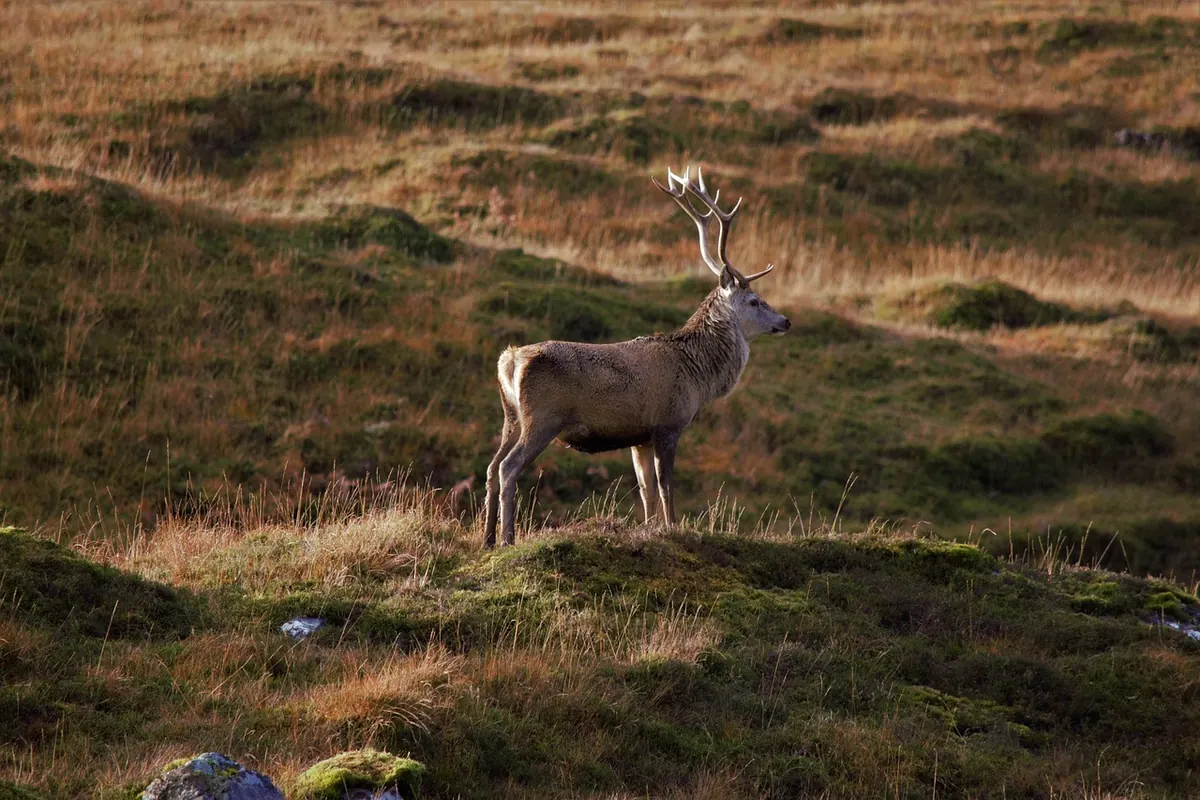
By the first week of October, a still morning on Exmoor or in the Cumbrian fells carries a sound that stops walkers mid-step: a deep, chesty roar out in the mist. It belongs to a red deer stag, Britain's largest land mammal, and it means the rut is on. For about six weeks each autumn, normally wary animals become loud, visible and single-minded — which makes this both the best and the most sensitive time of year to watch them.
Few wildlife spectacles in Britain are as accessible. You do not need a hide, an expensive lens or a permit. You need an alarm clock, a pair of binoculars and the patience to stand still in the cold for an hour. Get it right and you will watch something that has been unfolding in these islands for thousands of years, largely unchanged: stags settling ancient arguments out in the open, in front of you, at close range.
What Happens During the Rut
The rut is the red deer breeding season. As hinds come into season through the autumn, stags compete for the chance to mate, and they do it in the open: roaring, posturing, pacing in parallel and, occasionally, fighting. It is a contest of stamina as much as strength, and the winner is often not the heaviest animal but the one who can keep going longest.
A successful stag gathers a harem of hinds and then spends weeks holding it together — moving them on, rounding up stragglers, chasing off rivals. He barely eats. By November an older stag can look gaunt, his coat torn and his ribs showing. Antlers are grown over summer, stripped of velvet in late August or early September, and hard bone by October; they serve as much for display as for combat. Most contests end with one stag walking away.
Roaring, Posturing and the Long Stand-Off
Most of what you will actually witness is not fighting at all. It is negotiation. Two mature stags will walk parallel lines, heads high, roaring at each other for ten minutes or more, each waiting for the other to blink. The roar itself is a serious physical act, produced deep in the chest and capable of carrying hundreds of metres across a valley. Research on the Isle of Rum showed that stags can judge a rival's size and condition from sound alone — a lower, faster, more persistent roar signals a bigger animal. Many contests are decided before a single antler connects.
When a fight does happen, it is startlingly fast and usually brief. The stags lock antlers and push, twisting, until one loses his footing or his nerve. Injuries occur, and very occasionally a stag is killed, but the usual outcome is a bruised ego and a retreat. The defeated animal rarely goes far; he will drift to the edge of the harem, graze, wait, and try again in an hour.
Alongside the stags, the hinds are doing their own quiet work. They are not passive prizes. They move, they drift, they decide where to graze, and a stag who cannot keep his hinds together will lose them one by one to a neighbour. This is why the best watching is often not a single dramatic duel but a whole herd shifting slowly across a hillside, with one stag circling, chivvying and calling.
When to Go: The Rutting Calendar
Timing shifts with latitude and weather, but the shape of the season is reliable. Activity builds from the last days of September, peaks in the first three weeks of October and tails off through early November. Highland and northern populations tend to run a week or two later than those in the south-west, and a mild, wet autumn can delay things further.
- Late September — first roars, mostly at dawn.
- Early October — harems forming; roaring from first light.
- Mid October — usually the best window for a full day of activity.
- Late October — still busy in the Highlands and the south-west.
- Early November — the odd stag calling; most have stopped.
Dawn is the golden hour. Stags are at their most vocal in the ninety minutes after first light, and again in the final hour before dusk. Midday, especially on a warm day, they tend to lie up with the hinds and go quiet. If you have only one morning to spare, choose a cold, still, bright one after a frost: sound carries further, the deer are more active, and your own footsteps are less likely to give you away.
Where to Watch: The Best Places in the UK
Red deer are found in good numbers across Britain, and some of the finest rutting happens within an hour of a car park. The following are reliable, well-established places to start.
South-West England
- Exmoor, Somerset and Devon — the classic British rut. The herds around Dunkery Beacon, Horner Wood and the Brendon Hills are large, and the open moor makes them relatively easy to find.
- The Quantocks — quieter than Exmoor and often overlooked, with good access from the villages below.
- The New Forest and Purbeck, Dorset — smaller populations, but easy to combine with a walk and a pub lunch.
Northern England
- The Lake District — the fells around Martindale, Mardale and Ennerdale hold red deer, though the herds are more scattered than in the south-west.
- The North York Moors and the Yorkshire Dales — good numbers along the moorland edges, particularly in the early morning.
Scotland
- The Isle of Rum — home to the longest-running red deer study in the world, and arguably the best place in Britain to watch wild rutting behaviour.
- The Isle of Jura — famously deer-dense; the ferry crossing alone sets the mood.
- Torridon, Wester Ross and the Cairngorms — big, wild country and genuinely wild deer.
- Galloway Forest Park — accessible herds and some of the darkest skies in Europe to match.
In some of these places the deer are truly wild; in others they are managed as part of an estate or a deer park. Neither is a bad thing to watch, but it is worth knowing which you are looking at, because it changes how closely you should approach and how much you should trust their tolerance of people.
How to Watch Well: Fieldcraft and Etiquette
The rut is the one time of year when red deer are easy to find and equally easy to disturb. A stag who has spent three weeks holding a harem together may abandon it if pushed too hard, and hinds that are repeatedly moved lose condition before winter. Watching well is mostly about being unobtrusive.
- Arrive before dawn and stay put. Half an hour of standing still will show you more than two hours of wandering about.
- Use the wind. Deer rely on scent. Approach into the wind or across it, never with it at your back.
- Keep your distance. If an animal stops feeding, stares at you or moves away, you are too close. Back off slowly and quietly.
- Stay off the skyline. Use walls, gorse, bracken and dips in the ground as cover.
- Never get between a stag and his hinds. That is the quickest way to provoke a charge and the surest way to break up a harem.
- Keep dogs on a lead. No exceptions during the rut.
- Leave drones and playback calls at home. Playback in particular can pull a stag away from real hinds and skew the very behaviour you came to see.
Binoculars are essential; a spotting scope is a luxury. A flask, gloves and waterproof trousers make a cold, still morning survivable, and a quiet jacket in dull greens or browns makes you less conspicuous. Above all, remember that you are watching animals in the middle of the most demanding few weeks of their year.
Take nothing but photographs, leave nothing but footprints, and give the stag the space to be a stag.
After the Rut: What Happens Next
By mid-November the roaring stops, the harems disperse and the stags drift away to feed and recover. It is a hard winter for the oldest animals, and many will not see another autumn. The hinds, meanwhile, carry the next generation through the winter and calve the following June. Antlers drop in spring, and by July the new set is already growing again beneath its covering of velvet.
That cycle is worth holding onto when you stand in the mist listening to a roar. What you are hearing is not simply a noise. It is the sound of an animal betting everything on six weeks of autumn, and doing it in the same way it has done it since long before anyone thought to write it down.
Photo: hannahwilbraham / Pixabay